
Half Guard Basics: Staying Safe and Getting Back Up
Esta página ainda não foi traduzida; mostrando a versão em inglês.
Half guard is when you trap one of your partner's legs between yours while they control your upper body. It is a defensive and attacking position at the same time. Beginners should learn to stay on their side, frame with the knee shield, win the underhook and avoid being flat on their back.
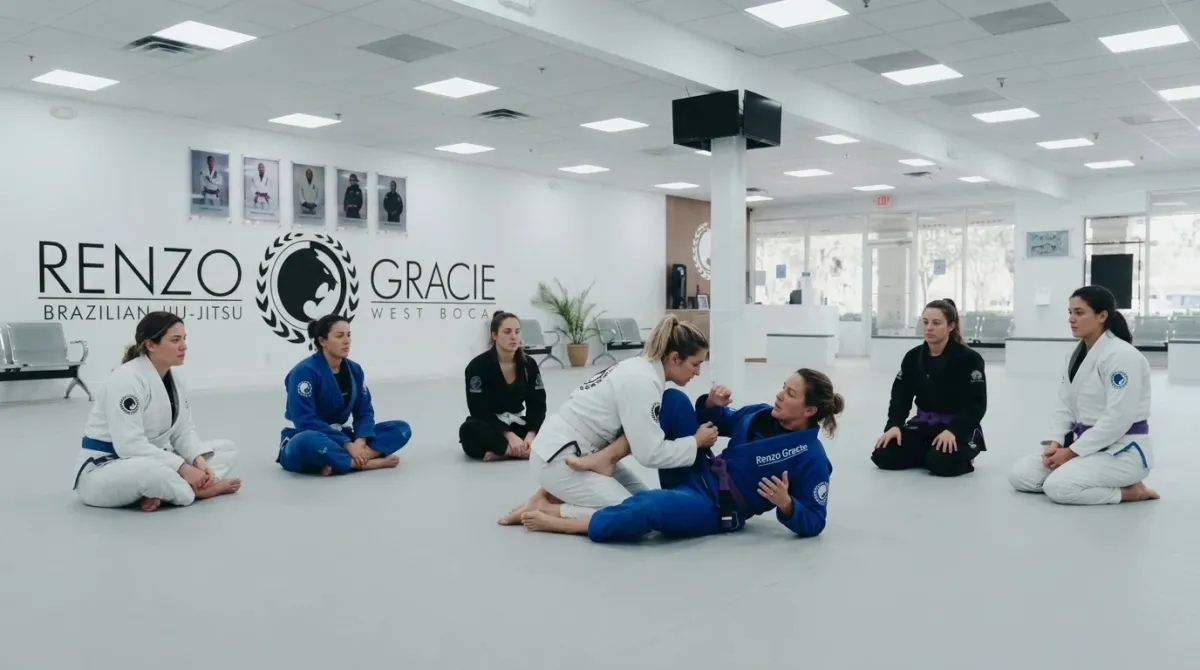
Half guard appears in almost every class, often when a guard pass is halfway done or when a student is trying to survive in a bad spot. The idea is simple: one of your partner's legs is trapped between yours. What you do next determines whether you recover guard, sweep, or get crushed. This guide teaches the safe fundamentals.
What is half guard and when do you end up there?
Half guard means you are on your back or side with your legs wrapped around one of your partner's legs, while the other leg is free. It often happens when your closed guard opens, when you recover guard from a pass or after a mount escape. Because your partner can use their weight and shoulder pressure, half guard can feel heavy at first.
It is also full of opportunities. From half guard, you can sweep, take the back or return to a stronger guard. If you want a quick refresher on why this matters, our entry on guard explains the idea of controlling a partner with your legs.
Step by step: a safe half guard
- Turn onto your side, facing your partner, rather than lying flat on your back.
- Keep your knees between you and your partner. Place your top knee in front of their chest or hip as a shield.
- Frame with your forearm across their neck or collarbone area, without pushing on the face.
- Slide your bottom arm under their arm to get an underhook, and keep your elbow close to your own ribs.
- Use the underhook to come up onto your elbow, then to your hand, and shift your hips back.
- Choose your direction: sweep to the top, return to full guard or stand up if you can do it safely.
Key details that make it work
- Stay on your side. Flat on your back, your partner's shoulder pressure takes over.
- Fight for the underhook early. It is the key to getting up.
- Keep your knee shield between your bodies to control distance.
- Keep your head from being pinned to the mat by moving it off the line of their shoulder.
- Hold their trapped leg firmly with your legs but do not use so much force that you tire out.
- Breathe. Calm half guard players last longer.
How to drill it
Begin with a partner who gives gentle pressure. Practice turning to your side and placing the knee shield ten times in a row. Next, practice getting the underhook and bringing your elbow to the mat. Add light resistance, and then try a basic escape back to closed guard. Repeat each part slowly until it feels automatic. Short, focused rounds are better than long, tiring ones.
Positional sparring can be very useful here. Start with your partner in top half guard and try to recover guard or come up, while they try to flatten you. You can also combine it with a hip bump sweep when you return to closed guard.
How to stay patient in the position
Half guard is often a slow, tense position where small details decide the outcome. Do not rush to sweep in the first second. Instead, focus on your breathing, your frames and your hip angle, and let your partner commit their weight before you move. Many students find that waiting for the right moment makes the underhook easier to win.
Remember that you can always return to full guard if the sweep is not there. A calm retreat is better than a panicked scramble, and it keeps your partner guessing.
Common mistakes and safety
The biggest mistake is lying flat and stiff, which hands your partner the crossface and the pin. Another is pushing against the face or neck with a straight arm, which is unsafe and gives away an easy opening for your partner. Some students also reach for the far arm and expose their own neck.
Take care with your knees and hips. Do not let your partner twist your trapped leg in an uncomfortable direction, and tap or tell them if something hurts. Keep your movements smooth and your communication clear. Always train with a partner you trust and listen to your instructor's advice.
Where to go from here
Half guard connects to side control and mount, so learn how to escape those positions with the side control escape and the mount escape. When you want to keep your guard from getting passed in the first place, study guard retention basics and the structure of closed guard.
Curious to try it with an experienced coach nearby? Book a free trial class at Renzo Gracie West Boca Raton in Boca Raton. If you prefer a women-only environment, the women's program is a welcoming place to start, and the adults program offers more options.
Passo a passo
Turn to your side
Do not stay flat; rotate so you face your partner with your knees between you.
Place the knee shield
Put your top knee in front of their chest or hip to control distance and stop the pressure.
Frame safely
Use a forearm on the collarbone or shoulder area, never pushing on the face or neck.
Win the underhook
Slide your bottom arm under their arm and keep your elbow close to your ribs.
Come up to the elbow
Use the underhook to rise to your elbow and then your hand while shifting your hips back.
Choose your exit
Recover full guard, sweep or stand up when it is safe, keeping control of their trapped leg.

 Portuguese