
Closed Guard Fundamentals: Control, Posture and Angles
Closed guard means lying on your back with your legs locked around your partner. Its purpose is control: you break their posture, manage their hands, and create angles for sweeps and submissions. Learn the basic shape and the habits that keep you safe before chasing any advanced attack.
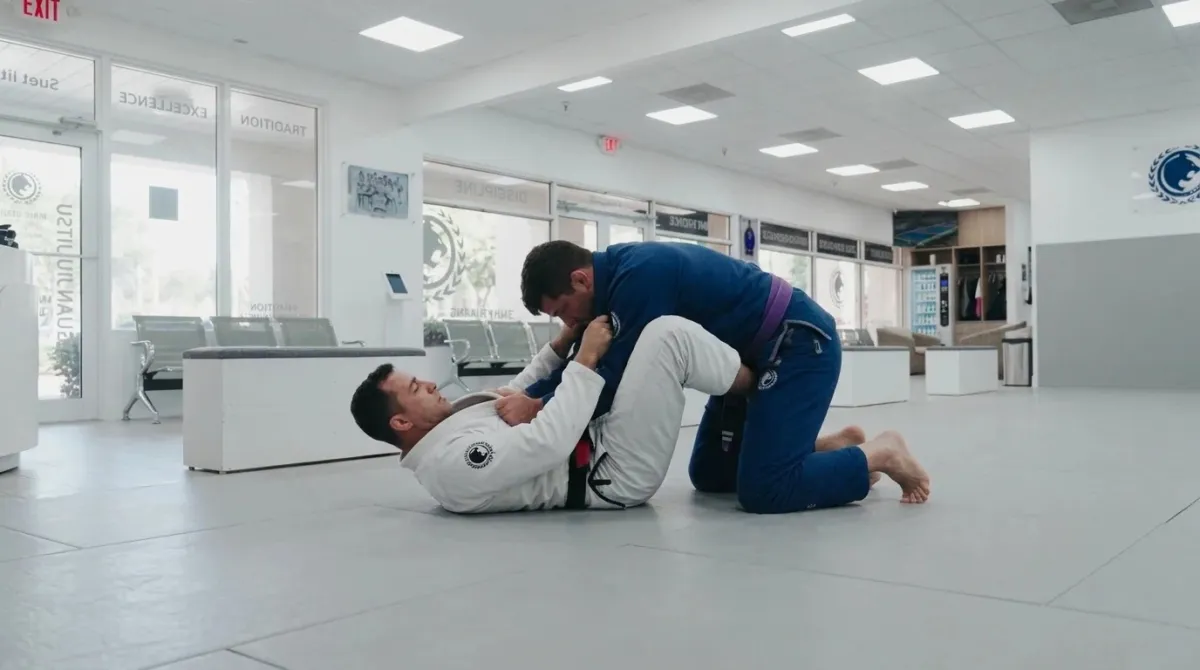
Closed guard is usually the first guard a student learns, and it is a great place to understand how jiu-jitsu really works. Instead of defending from underneath, you use your legs to hold your partner close, steer their posture and decide what happens next. This guide covers the shape of the position, the steps to build it, and the habits that make it effective.
What is closed guard and why learn it first?
Closed guard is a position where you are on your back and your legs are wrapped around your partner's waist with the ankles crossed. It is a safe place for beginners because their hands and hips are restricted, and it leads to some of the best-known sweeps and submissions. In our classes we often see it used as the starting point for learning the rest of the guard game.
It is also a lesson in patience. Closed guard rewards small, repeated pressures rather than explosive moves. If you want the definition of the position in plain language, read our entry on guard.
Step by step: building a good closed guard
- Sit tall as your partner kneels in front of you, with your hips close to theirs and your back flat on the mat.
- Wrap your legs around their waist and cross your ankles high on their back, near the belt line.
- Squeeze your knees together lightly so your partner cannot sit up straight and pull away.
- Use your hands to grip a sleeve or wrist and the collar or the back of their head. Pull their elbows toward you.
- Rotate your hips off center so you are at a small angle to your partner. Your head should not be directly below theirs.
- Choose your plan: a sweep, a submission or a transition.
Key details that make it work
- Keep your hips close. If your hips float away, your partner can stand up and open your guard.
- Break their posture before attacking. A partner who is sitting up tall is difficult to sweep or submit.
- Control the arms. Hands on your chest or hips allow them to push you away. Keep their elbows pinned to your body.
- Use your legs as a clamp and as a steering wheel. Squeeze and release to adjust the distance.
- Move your hips constantly. A guard that only lies flat is easy to defend.
- Stay relaxed. Gripping too hard wastes energy and slows you down.
How to drill it
Start with a cooperative partner who kneels and stays still. Practice locking and unlocking the guard, then pull their posture down twenty times. Next, ask the partner to push up a little while you rebuild the shape. Finally, add one simple attack, such as the scissor sweep or the armbar. Short, repeated rounds work better than one long sprint.
You can also practice the angle by shrimping your hips from side to side with the guard closed, so you learn how to turn without losing the lock. The hip bump sweep is a good partner for this kind of movement.
Common mistakes and safety
The most common mistake is lying flat and hoping something happens. Without angles and grips, your partner can open your guard and pass. Another mistake is crossing your ankles and then forgetting to control posture, which lets your partner sit back and stand up. Some students also squeeze their partner's neck or ribs too hard, which is uncomfortable and can be unsafe. Keep the pressure controlled and release when your partner signals discomfort.
Be careful when your partner tries to stand and open your guard. Do not let them drop their weight on your thighs or knees at an awkward angle; shrimp out and recover your guard instead. If you feel pain in the knee or hip, stop and tell your instructor. Hands should be kept safe, too, so avoid putting a hand in a place where it could be trapped.
Where to go from here
Closed guard connects to many other skills. If you are caught in the position as the top player, you will need to learn how to open and pass it, for example with a knee slice pass. To be a better guard player, study the triangle choke and the kimura. When your guard is passed, guard retention and half guard will help you recover.
Ready to feel it on the mat? Book a free trial class at Renzo Gracie West Boca Raton and our coaches will guide you through each step. You can also look at the adults program to find a class that fits your schedule. For a gentle introduction to how classes work, read your first BJJ class.
Step by step
Sit tall and close the gap
Face your kneeling partner with your hips close to theirs and your back flat, ready to wrap your legs.
Lock the legs
Wrap your legs around their waist and cross your ankles high on their back near the belt line.
Control posture
Grip a sleeve and the collar or back of the head, and pull their elbows in toward your body.
Squeeze lightly
Close your knees to stop them from sitting tall, and use the squeeze to adjust their distance.
Turn your hips
Rotate your hips to a small angle so your head is not directly under theirs.
Pick an attack
From this angle choose a sweep, submission or transition, and keep moving your hips as you go.

 English