
Self-Defense Fundamentals: What Jiu-Jitsu Teaches You
Esta página ainda não foi traduzida; mostrando a versão em inglês.
Self-defense fundamentals start long before any physical contact. Jiu-jitsu teaches awareness, distance, posture, balance and escapes, along with the calm to make good decisions under stress. Training builds useful skills, but no class can promise safety, so avoiding danger and leaving early always come first.
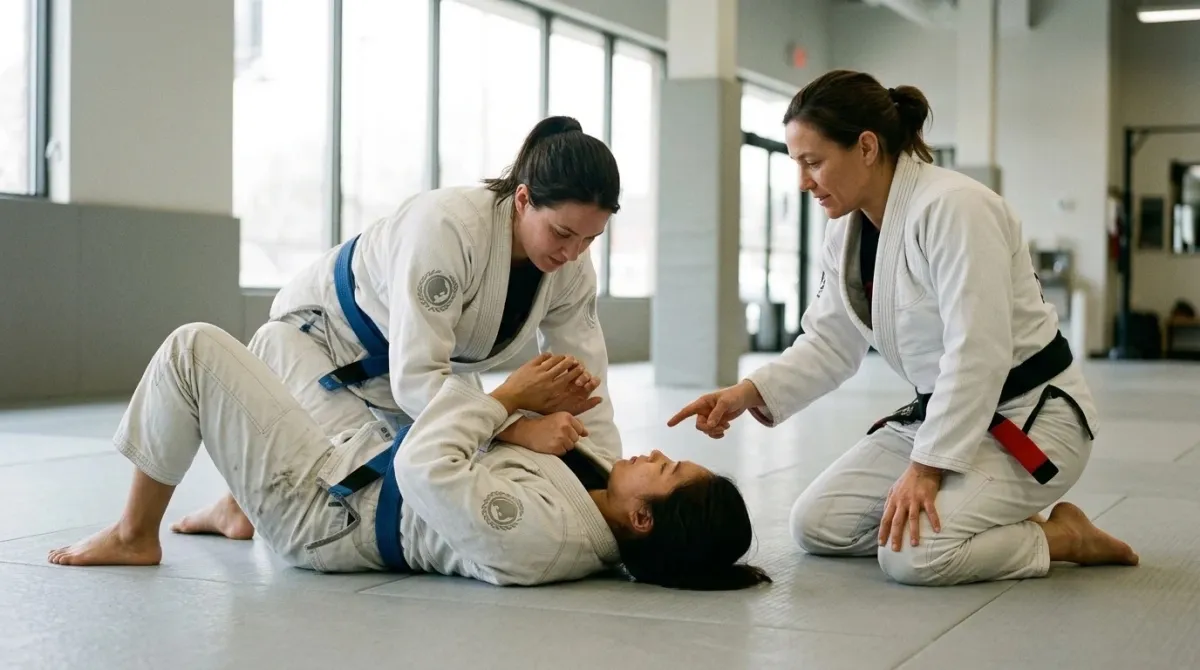
When people think about self-defense, they imagine dramatic moments. The reality is quieter. Real self-defense fundamentals are about attention, distance and good decisions, long before anyone touches you. Jiu-jitsu adds physical skills, but the mindset comes first.
What are self-defense fundamentals?
Self-defense fundamentals are the core habits that help you avoid trouble and respond calmly if it finds you. They include awareness of your surroundings, managing distance, keeping good posture and balance, knowing how to escape holds and choosing to leave whenever possible. Physical technique is only one part.
It helps to think of self-defense as layers. The first layer is avoidance: choosing safe places, trusting your instincts and leaving early. The second is communication: using a calm voice and body language to defuse tension. The third is physical skill, used only when other options are gone.
In our classes we teach that the best fight is the one you never have. Jiu-jitsu training builds confidence, and confident people tend to carry themselves in ways that avoid conflict.
Why is awareness the first skill?
Awareness is the first self-defense skill because most problems are easier to avoid than to solve. Noticing your surroundings, the people near you and your own feelings gives you time to choose a different path. Being present, rather than distracted by a phone, makes you a harder target.
- Walk with your head up and your phone away in unfamiliar places.
- Notice exits and well-lit areas when you enter a room or parking lot.
- Trust your instincts if a situation feels wrong.
- Let a friend or family member know your plans when appropriate.
Awareness does not mean fear. It is simply paying attention, the way you do when driving. Practiced regularly, it becomes automatic and lets you relax more, not less.
How does distance keep you safer?
Managing distance means keeping enough space between yourself and a possible threat so you have time to react. In practice it involves stepping back, placing obstacles between you and the other person and moving toward safety. Distance gives you options, and every option is valuable.
In jiu-jitsu class, you learn how close or far a partner must be to apply a grip or a hold. That sense of range is useful in everyday life. You start to notice when someone enters your personal space and how to calmly increase the gap.
Use your voice as a tool for distance. A firm, clear statement such as "Stop, stay back" draws attention and shows you are alert. Combined with movement away, it can end a tense moment without any contact.
What does good posture and balance do?
Good posture and balance make you harder to push, pull or take down. In jiu-jitsu, students learn to keep their head up, spine straight, knees slightly bent and weight centered. A balanced stance protects you and gives you power to move when you need to.
Balance is trained constantly on the mat. Every drill, from standing grips to ground transitions, teaches you to feel where your weight is and to recover when it shifts. These skills carry into daily life, from slippery floors to crowded stairs.
Beginners often discover that posture matters more than strength. A relaxed, upright body with a stable base can resist much more force than a tense, hunched one. Your instructor will correct small details that make a large difference.
How do escapes work?
Escapes are techniques that help you get out of a hold, create space and return to a safe position. Jiu-jitsu students learn escapes from grips, pins and chokes by using angles, hip movement and timing rather than force. The goal is to free yourself and stand up or move away.
Common escape ideas include:
- Protecting your head, neck and airway first.
- Creating a little space with your hips or frames.
- Turning your body to reduce pressure.
- Moving to your feet or away from the threat.
These ideas are simple, but they take regular practice to work under stress. That is why live training in a controlled environment matters. You learn to apply them with a resisting partner who respects your safety.
Why does staying calm matter so much?
Staying calm matters because panic wastes energy and clouds decisions. Jiu-jitsu training exposes you to pressure in a safe setting, so you learn how your body reacts and how to breathe through it. Over time, calmness becomes a habit that serves you in many parts of life.
When you are held down by a heavier partner in class, your first reaction may be to thrash. With coaching, you learn to slow your breathing, protect your neck and look for small openings. That experience builds trust in your ability to think under stress.
Calm does not mean passive. It means choosing your actions deliberately, and it is one of the most valuable things the mat can teach.
What is the role of de-escalation?
De-escalation means reducing tension through calm words, relaxed body language and a willingness to walk away. It is a core part of self-defense because it can end a conflict before it begins. A confident, respectful tone often works better than a loud or aggressive one.
Practical de-escalation habits include keeping your hands visible and relaxed, speaking slowly, avoiding insults and giving the other person room to save face. Pride is the enemy of safety, and letting someone else "win" an argument is often the smartest move.
Jiu-jitsu students often become better at this because the mat teaches humility. When you lose rounds regularly and learn from it, you lose the need to prove yourself in daily life.
Is jiu-jitsu enough for self-defense?
Jiu-jitsu is a strong foundation for self-defense, but it is not a complete answer by itself. Real situations can involve multiple people, weapons, unfamiliar surroundings and legal consequences. Awareness, avoidance and good judgment remain essential, and training should be viewed as one tool among many.
We are honest with students about this. A class can teach control, escapes and confidence, but it cannot predict what happens in a real encounter. Anyone who promises total safety is not telling the truth.
If you want guidance on legal rules about self-defense, consult a qualified attorney or local authorities. Our role is to teach safe technique, healthy habits and respect for others.
What is the difference between sport training and self-defense?
Sport jiu-jitsu has rules, referees and points, while self-defense focuses on getting safely away from danger. The skills overlap, such as balance, control and escapes, but the goals differ. Good academies teach both and explain when each mindset applies.
In sport training, you may choose to stay in a position to score. In self-defense, you would stand up and leave as soon as you can. Understanding this difference keeps your training honest and your expectations realistic.
Whichever path you choose, regular live practice builds athletic ability and composure. Students who enjoy competition can explore the competition team, and those who prefer practical skills can focus on the fundamentals in the adult program.
How does training prepare you to act under pressure?
Jiu-jitsu training prepares you to act under pressure by letting you practice with a resisting partner in a safe setting. You feel the stress of being controlled, learn to breathe and think, and slowly build trust in your skills. This experience is hard to get from watching videos alone.
The key is gradual exposure. Drills begin cooperative, then move to light resistance and finally to live rounds. At each stage, the instructor sets clear rules and everyone taps early, so the pressure is real but controlled.
Over time, students notice that stressful situations outside the gym feel more manageable. The body remembers what it is like to stay calm while uncomfortable, and that memory is powerful.
What mistakes should you avoid when learning self-defense?
Common self-defense mistakes include overconfidence, relying on a single technique, ignoring awareness and skipping regular practice. Real safety comes from habits and judgment, not from a trick. Stay humble, keep training and remember that walking away is often the strongest choice.
- Believing that one class makes you ready for anything.
- Practicing only cooperative drills and never testing under pressure.
- Ignoring the legal side, such as the limits of reasonable force.
- Using skills to show off or to bully others.
Our instructors emphasize responsibility. Skill without restraint is not self-defense, and students who train with us are reminded that jiu-jitsu is for protection, not aggression.
Who can benefit from self-defense training?
Almost anyone can benefit from self-defense training: adults, teens, women, parents and older students. Programs are scaled for different ages and fitness levels, and no experience is needed to start. The most important factors are a good instructor, a safe environment and consistent practice.
Women may enjoy a supportive setting in the women's program, and teenagers can build skills and confidence in the Teens program. Anyone who wants personal attention can consider a private lesson.
Whatever your background, it is never too late to learn. A calm, confident approach to safety is within reach of everyone willing to practice.
How can you start learning self-defense fundamentals?
The simplest way to start learning self-defense fundamentals is to try a beginner class with a qualified instructor. At Renzo Gracie West Boca Raton, you can join a free trial class, meet the team and see how training works. Wear comfortable clothes and bring a water bottle.
Look over the class schedule and book a free trial class that suits your week. We welcome beginners from Boca Raton and across South Florida, and we are happy to answer questions about what you will learn.
Perguntas frequentes
Does jiu-jitsu really work for self-defense?
Jiu-jitsu teaches practical skills such as balance, control, escapes and calm decision making, which are valuable in many situations. No martial art can promise safety, though, and every real situation is different. Training works best alongside awareness, good judgment and a strong preference for avoiding conflict.
How long does it take to learn useful self-defense skills?
Basic skills like posture, distance and simple escapes can begin to feel natural within weeks to months of regular training. Skill develops with repetition and live practice. Your instructor can show which fundamentals matter most for beginners and how to practice them safely.
Is self-defense training safe for beginners?
Self-defense training can be safe when taught by a qualified instructor with clear rules, controlled drills and early tapping. Beginners start slowly and add intensity only as they are ready. Tell your instructor about injuries or concerns so that exercises can be adjusted.
Should I fight back if someone threatens me?
Personal safety decisions depend on the situation, and no article can give legal or tactical advice. A general principle is to avoid conflict, create distance and seek help when possible. For legal questions about self-defense, consult a qualified attorney or local authorities.

 Portuguese