
A Simple Mobility Routine for Jiu-Jitsu Training
Esta página ainda não foi traduzida; mostrando a versão em inglês.
A jiu-jitsu mobility routine focuses on hips, spine, shoulders, neck and ankles. Ten gentle minutes before class, or at home on off days, can help your body move more freely on the mat. Move slowly, never push into sharp pain, and ask a doctor if you have an injury.
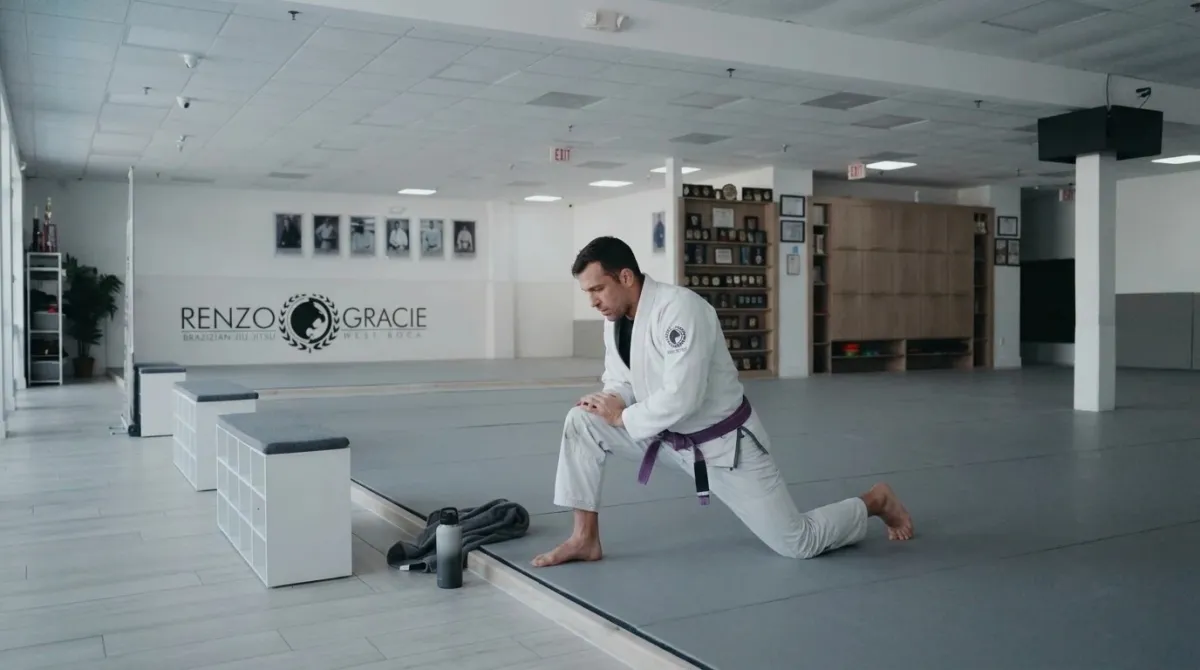
Jiu-jitsu asks your body to bend, twist, bridge and balance in unusual ways. A short, regular mobility routine can help your hips, spine and shoulders feel ready for those positions. This guide gives you a simple sequence you can do before class or at home, along with the reasons behind each move and the safety rules that matter.
What is mobility, and why does it matter in jiu-jitsu?
Mobility is your ability to move a joint smoothly through a useful range of motion under control. In jiu-jitsu, that means turning your hips in guard, bridging out of mount, rotating your spine in a scramble and keeping your shoulders healthy in grips. Better mobility makes those movements feel easier and less cramped.
It is different from flexibility, which is how far a muscle can stretch passively. Mobility combines flexibility with strength and control. A student can touch their toes and still feel stuck on the mat, while another with less stretch moves well because their joints are trained to work together.
Mobility work does not replace technique, and it does not guarantee that you will avoid injury. It is one useful habit among others, such as good drilling and smart rest. For more on staying healthy, see how to avoid injuries in jiu-jitsu.
When should you do this routine?
You can do this routine before class, on rest days or in the evening to unwind. Before class, keep the movements dynamic and light. On rest days, you can hold positions a little longer and breathe slowly. Most people feel good with ten to fifteen minutes, and a calm pace is more important than a long session.
Our instructors run a warm-up at the start of class, so you do not need to arrive with a complete routine. This sequence is meant as a supplement for the days when your hips are tight, you sit at a desk all day, or you want something to do between classes.
What are the basic safety rules?
Move slowly, breathe normally and stay out of sharp pain. A stretch should feel like gentle tension, not pinching, burning or numbness. If a movement hurts in a joint, stop and skip it. Talk to a doctor or physical therapist if you have an injury, surgery history or ongoing pain, because this article cannot replace personal medical advice.
A few simple rules:
- Warm up first with a minute or two of easy walking or marching in place.
- Do not bounce in a stretch.
- Never force a position that makes your knees, back or neck uncomfortable.
- Stay on a non-slip surface with enough space around you.
- Stop if you feel dizzy, and sit down.
Step 1: Cat-cow for the spine
Cat-cow gently moves the spine through flexion and extension. Start on your hands and knees with your hands under your shoulders and knees under your hips. Inhale as you let your belly drop and your chest lift, then exhale as you round your back toward the ceiling. Repeat for eight to ten slow breaths.
This helps with the spinal movement you use when you shrimp, bridge and sit up. Keep your neck long and avoid pushing your head up too far.
Step 2: Thoracic rotation for the upper back
Thoracic rotation opens the middle of the back, which many desk workers keep stiff. From hands and knees, place one hand behind your head. Rotate that elbow down toward the opposite wrist, then rotate it up toward the ceiling, following it with your eyes. Do eight slow reps per side.
Rotation in the upper back helps you turn in your guard, look over your shoulder and escape from side control without twisting your lower back too hard.
Step 3: Hip circles and the world's greatest stretch
Start in a low lunge, with your right foot forward and your left knee on the floor. Place both hands inside your right foot. Gently sink your hips forward and down, then rotate your right arm toward the ceiling. Return and repeat five times, then switch sides. Many coaches call this the "world's greatest stretch" because it works hips, groin, hamstrings and the upper back together.
For hip circles, stay on hands and knees, lift one knee and draw slow circles with it, like a dog marking a path. Do six circles in each direction on each side. These movements prepare your hips for guard retention and for the shrimping you do all class.
Step 4: 90/90 hip switches
Sit on the floor with both knees bent at about ninety degrees, one leg in front and one to the side. Keep your chest tall and rotate your knees from side to side, moving slowly. If it is hard, sit on a folded towel. Do eight to ten transitions.
The 90/90 position trains internal and external rotation of the hips, which you use every time you open your guard, climb your knee through in a pass or sit up from the bottom.
Step 5: Frog stretch for the groin
Start on hands and knees, then slide your knees apart while keeping your ankles behind them. Sit your hips back toward your heels. Hold for twenty to thirty seconds and breathe slowly. Use a folded mat under your knees if they feel sensitive.
If your knees complain, make the position narrower or skip it. This stretch is helpful for students who feel tight when they hold wide guard, but it should never feel sharp.
Step 6: Shoulder circles and wall slides
Stand tall and make slow shoulder circles forward and back, ten each way. Then stand with your back against a wall, bend your elbows and keep your arms against the wall as you slide them up and down. Do eight reps without letting your lower back arch away from the wall.
Healthy shoulders matter in jiu-jitsu because grips, frames and escapes load them all the time. If you notice pain on overhead movement, stop and speak with a medical professional.
Step 7: Neck mobility
Sit or stand tall and turn your head slowly to look over each shoulder, then lower your ear gently toward each shoulder. Do five slow reps in each direction. Do not roll your neck in big circles or push with your hands, and keep it gentle.
Your neck takes pressure in many positions, so respect it. If you ever feel tingling or pain in the arms, stop and ask a professional.
Step 8: Ankle circles and calf stretch
Ankles matter for shrimping, framing and standing up. Sit and draw slow circles with each foot, ten in each direction. Then lean against a wall with one leg back, heel down, and hold the calf stretch for twenty seconds on each side.
How do you put it together?
Do the steps in order, spending about one minute on each. That gives a routine of around ten minutes that you can repeat daily or a few times a week. Beginners can do one round, while experienced students might add a second round with slower holds. Listen to your body and keep the routine enjoyable.
A sample plan:
- Easy walk or march for one minute.
- Cat-cow and thoracic rotation.
- Lunge with rotation, hip circles and 90/90.
- Frog stretch and shoulder wall slides.
- Neck and ankle work to finish.
Pair this with good sleep and recovery habits, which you can read about in our guide on recovery and sleep for BJJ athletes. If your goal is stamina, see the conditioning guide.
What if you are older or very stiff?
Start smaller and go slower. Students in their forties, fifties and beyond can benefit from regular mobility work, as long as they respect their limits. Use a chair or wall for support, hold positions for shorter periods and check with a doctor if you have joint concerns.
Our Tatame 40+ and Tatame 50+ programs are designed with mature students in mind, and our guide on starting jiu-jitsu after 40 offers practical ideas. Progress comes from consistency, not from forcing flexibility.
How can you bring this into your Boca Raton training?
Use the routine as a bridge between classes, then notice how your body feels on the mat. Many students tell us that a few minutes of hip and spine work make drills like shrimping and bridging smoother. Share any tight spots with your instructor, who can suggest modifications.
To feel how mobility and technique come together, book a free trial class at Renzo Gracie West Boca Raton. Review the class schedule, arrive a few minutes early to warm up and ask our coaches anything about your hips, shoulders or back.
Perguntas frequentes
How long should a jiu-jitsu mobility routine take?
Ten to fifteen minutes is enough for most people. A short routine done regularly is more useful than a long one done once. Keep the pace slow and stop if anything hurts.
Should I stretch before or after class?
Light, dynamic movement before class helps you warm up, while longer holds are better after class or on rest days. Your instructor will also lead a warm-up at the start of training.
Will mobility work prevent injuries?
It can help your body move more comfortably, but it cannot promise to prevent injuries. Combine it with careful drilling, early tapping, good rest and guidance from your coach.
What if a stretch hurts?
Stop. Stretching should feel like gentle tension, not sharp pain. If pain continues or you have an injury, talk to a doctor or physical therapist.

 Portuguese