
How Jiu-Jitsu Builds Confidence in Kids and Adults
Esta página ainda não foi traduzida; mostrando a versão em inglês.
Jiu-jitsu builds confidence by giving students safe challenges, visible progress and a supportive community. Each class asks you to try something hard, fail safely and try again. Small wins add up, and many students find they carry that steadier self-belief into school, work and daily life.
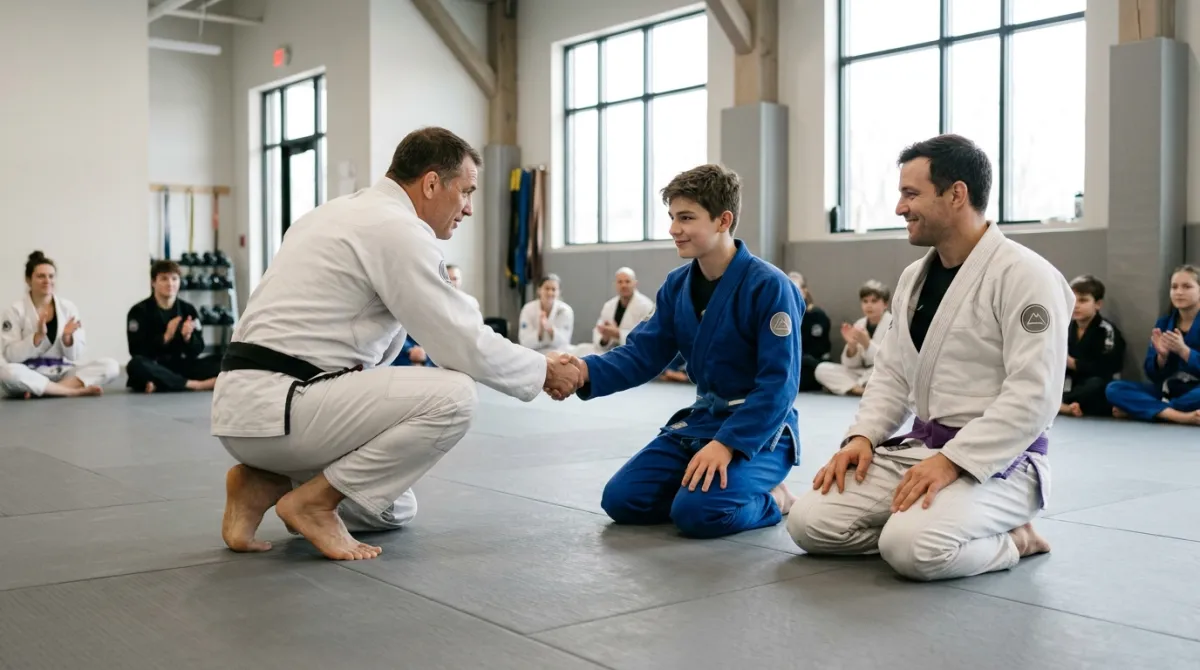
People often say that jiu-jitsu changed how they carry themselves. They stand a little taller, speak up a little more and worry a little less. It sounds like a big claim, so let us look at the practical reasons why jiu-jitsu builds confidence for so many students.
What does confidence mean on the mat?
On the mat, confidence means trusting that you can handle a challenge, learn from mistakes and stay calm under pressure. It is not about winning every round or feeling fearless. It is a quiet belief in your ability to try, adapt and keep going when things get hard.
That kind of confidence is earned slowly. In our classes we see students begin class unsure of every movement, then gradually notice that they can solve problems they once found impossible. The shift is subtle but real.
It also comes with humility. A confident jiu-jitsu student knows there is always more to learn, and that makes them open to feedback and kind to others.
How do small wins build self-belief?
Small wins build self-belief because each one proves that effort leads to improvement. In jiu-jitsu, you might finally land an escape you have been drilling, or stay relaxed in a position that once caused panic. Each success is clear, personal and earned.
Because techniques are practiced in steps, progress is easy to see. You can feel the difference between a clumsy first try and a smooth tenth repetition. Those moments teach the brain that practice works.
Many students keep a short list of wins after class: one thing learned, one thing improved, one thing to try next time. Over weeks, the list becomes strong evidence of growth.
Why does safe challenge matter?
Safe challenge matters because it lets you face discomfort without real danger. Jiu-jitsu puts you in difficult positions, with a partner who controls the pressure and stops when you tap. You learn that you can breathe, think and solve problems even when you feel stuck.
This experience is powerful. When you have been held down by a heavier partner and found a way to move, ordinary stress outside the gym can feel smaller. The body remembers that discomfort is something you can handle.
The key word is safe. A good academy controls intensity, teaches tapping early and matches partners thoughtfully. Confidence cannot grow where people feel unsafe.
How does tapping teach resilience?
Tapping teaches resilience because it turns failure into information. When you tap, you accept that a position beat you today, you reset and you try again. Students quickly learn that being caught is part of learning, not a verdict on their worth.
Over time, tapping loses its sting. You begin to treat each round as a puzzle, asking what went wrong and how to fix it. That mindset is a major life skill. It applies to exams, jobs and relationships as much as to the mat.
Instructors reinforce this by praising effort and curiosity. We often tell students that the best learners are the ones who are willing to tap, laugh and try again.
What role does the community play?
The community plays a big role because people take more risks when they feel supported. In a good academy, training partners encourage each other, share advice and celebrate progress. Knowing that others want you to succeed makes it easier to try difficult things.
- Experienced students help newcomers feel welcome.
- Partners offer tips and positive feedback.
- The group celebrates belt promotions and milestones.
- Everyone, regardless of rank, is expected to show respect.
Belonging has a quiet effect on self-esteem. When you know your presence matters to a group, you carry that feeling into the rest of your life.
How does the belt system support confidence?
The belt system supports confidence by giving students honest, visible markers of progress. Stripes and belts are earned through time, skill and character, so they carry real meaning. Looking at your belt reminds you of the effort you have invested and the growth that has already happened.
Children benefit from frequent goals, which is why youth programs include many steps. Adults appreciate the long view, knowing that each rank represents years of learning. In both cases, the system rewards patience instead of shortcuts.
It is wise to hold the belt lightly. Rank is a milestone, not an identity. The most confident students are those who stay curious no matter what color they wear.
Does it work the same for kids, teens and adults?
The principle is the same for all ages, although the details differ. Kids build confidence through games, praise and clear goals, teens through challenge and belonging, and adults through learning something new and overcoming ego. Each group benefits from a respectful, structured environment.
Parents can see how youth classes work on the Juniors program and Teens program pages. Adults can learn more about the adult program, and women who prefer a women-focused setting can read about the women's program.
Wherever you start, remember that confidence is a side effect of effort. You do not need it to begin. It arrives as you train.
How do you handle plateaus and frustration?
Plateaus and frustration are normal in jiu-jitsu, and handling them well is a confidence skill in itself. When progress feels stuck, slow down, ask your instructor for feedback and focus on one small detail. Most students find that a breakthrough arrives after a patient stretch of repetition.
Remind yourself that the learning curve is rarely a straight line. A week of confusion often comes before a week when everything clicks. Track your training in a notebook, and look back after a month to see what has changed.
It also helps to talk. Fellow students have been through the same thing and are usually happy to share how they got past it. Hearing that a purple belt struggled just as you do can be a relief.
What if you do not feel confident yet?
If you do not feel confident yet, you are in good company. Most students start jiu-jitsu feeling nervous, awkward or out of shape. Take it one class at a time, tell the instructor how you feel and focus on small improvements. Confidence follows consistent effort, not the other way around.
It helps to keep expectations realistic. Jiu-jitsu is not a quick fix, and it is not a replacement for professional support when someone is struggling with anxiety or low mood. If you have concerns about your mental health, speak with a qualified professional.
What the mat can offer is a steady place to practice courage in small doses. Many people find that this practice makes the rest of life feel a little lighter.
Where can you start building confidence?
You can start building confidence by trying a class at Renzo Gracie West Boca Raton. A free trial class lets you meet the instructors, see how training works and decide whether the mat feels right. Children, teens and adults are welcome in their own programs.
Check the class schedule and book your free trial class. Whether you live in Boca Raton or nearby, the first step is simply showing up. The rest builds one class at a time.
Perguntas frequentes
How long does it take for jiu-jitsu to build confidence?
Confidence grows at different speeds for each person. Many students notice small shifts within a few weeks, such as feeling calmer in class, and bigger changes over months of regular training. Focus on steady attendance and small wins rather than a deadline.
Can shy people benefit from jiu-jitsu?
Yes. Jiu-jitsu gives shy people structured ways to interact, with clear roles and a shared task. Partner drills make conversation easier, and a supportive instructor sets a welcoming tone. Many quiet students find that the mat becomes a place where they feel at ease.
What if I keep losing in practice?
Losing in practice is a normal part of learning, and every experienced student has done it thousands of times. Practice rounds are for learning, not winning. Each defeat shows you what to improve, and persistence is what builds real confidence.
Is confidence from jiu-jitsu the same as being aggressive?
No. Confidence in jiu-jitsu usually shows up as calm, humility and self-control. Students learn to stay relaxed under pressure and to treat partners with respect. A confident student rarely needs to prove anything.

 Portuguese