
How Long Does It Take to Get a BJJ Blue Belt?
Esta página aún no está traducida; mostrando la versión en inglés.
There is no fixed number of months for a blue belt. It depends on how often you train, your background, your instructor and how you learn. Most students need patience measured in years, not weeks. Focus on steady attendance and understanding the basics, and let your instructor decide when you are ready.
Every white belt eventually asks how long it will take to earn a blue belt. It is a fair question, and it deserves an honest answer rather than a magic number. In jiu-jitsu, promotions are decided by instructors, not by a calendar, so the time varies from person to person. This guide explains what shapes your timeline and how to make the most of it.
How long does it take to get a blue belt in BJJ?
There is no set time to earn a blue belt, and any guaranteed number would be misleading. Blue belt is the first promotion after white, and it generally takes a consistent student a long stretch of regular training, usually counted in years rather than weeks. Each academy sets its own standards, so your instructor decides when you are ready.
That uncertainty can feel frustrating, but it exists for good reasons. Belts in jiu-jitsu are meant to reflect what you can actually do on the mat, such as defending, escaping and keeping your composure, not simply how long you have shown up. Two students can start on the same day and be promoted at very different moments.
If you want to understand the whole ladder, read our BJJ belt system explained guide, which covers colors, stripes and what each rank represents.
What actually decides when you are promoted?
Your instructor decides, based on skill, understanding and attitude, together with how consistently you train. Different academies weigh these things differently, which is why comparing yourself with a friend at another school rarely helps. At Renzo Gracie West Boca Raton, promotions are made by the coaching team, who watch your development week after week.
Common factors that coaches consider include:
- Attendance and consistency. Showing up regularly matters more than occasional bursts of effort.
- Technical understanding. Can you explain and perform the basic positions, escapes and submissions?
- Performance in live practice. Do you stay calm, defend well and apply what you learned?
- Attitude and mat behavior. Respect, safety and care for your partners are part of the picture.
- Time in grade. Coaches usually want to see growth across many months, not days.
None of these can be rushed, but all of them can be improved with good habits.
How does training frequency change the timeline?
Training more regularly usually helps you improve faster, because the skills have less time to fade between sessions. A student who attends steadily will often progress more smoothly than one who trains in random bursts. Still, more is not always better, because rest and recovery are part of progress.
A realistic weekly rhythm is the one you can keep for months. If you want ideas on setting a sustainable routine, our guide on how often beginners should train gives practical advice. Remember that injuries are the biggest enemy of consistency, so look after your body with the tips in how to avoid injuries in jiu-jitsu.
Do background and age matter?
Yes, they can, but they do not decide your destiny. A student with a wrestling or athletic background may feel comfortable sooner, while someone entirely new to sports may need extra time to learn how their body moves. Age, flexibility and previous injuries also shape the path.
That is not a bad thing. Many people begin in their forties or later and progress well by training smartly and listening to their body. Our guide on starting jiu-jitsu after 40 speaks to that group. The goal is to improve compared to your own starting point, not to match someone else.
What should a blue belt be able to do?
A blue belt should understand the basic positions and have a simple game they can use under pressure. That usually means knowing how to defend, escape common bad positions, keep control of key positions and finish a few reliable submissions. It does not mean perfection, and no coach expects a blue belt to be flawless.
Examples of skills that coaches like to see growing in a white belt include:
- Escaping mount and side control, such as the elbow-knee mount escape and the side control escape.
- Holding a closed guard and attacking with an armbar, triangle or scissor sweep.
- Passing guard with control, for example with the knee slice pass.
- Staying calm and tapping early when caught.
These are guideposts, not a checklist stamped on a form. Your instructor may value other things depending on the school.
How can you progress steadily without obsessing about the belt?
Focus on what you can control: attend regularly, ask questions, drill the basics and rest well. The belt is a result of good habits, not the goal itself. Students who chase promotion often tighten up, while students who enjoy the learning tend to relax and improve.
A few habits that help:
- Set small goals. For example, learn one escape this month and practice it every class.
- Keep a simple notebook. Write down one or two details after each class so they are not lost.
- Drill more than you spar. Repetition builds the movements that you rely on in live practice.
- Ask your coach for feedback. A short question like "what should I work on?" gives you a clear target.
- Be patient with plateaus. Everyone has weeks where nothing seems to work, and those weeks are normal.
If you feel stuck, read about breaking through plateaus, and learn the difference between drilling and rolling early.
What should you ask your instructor about promotion?
Ask what the academy looks for and what you can work on next. A short, respectful question after class, such as "what is the most useful thing for me to improve right now?", gives you a clear direction and shows that you care about the process. Coaches usually appreciate students who ask about skills rather than dates.
It also helps to ask how your academy handles stripes and belt tests, since practices differ. Some schools promote quietly after class, while others hold a small ceremony. Knowing the culture ahead of time removes guesswork and lets you focus on training. If your coach says you are not ready yet, treat that as useful information and ask for two or three specific things to improve.
What about stripes?
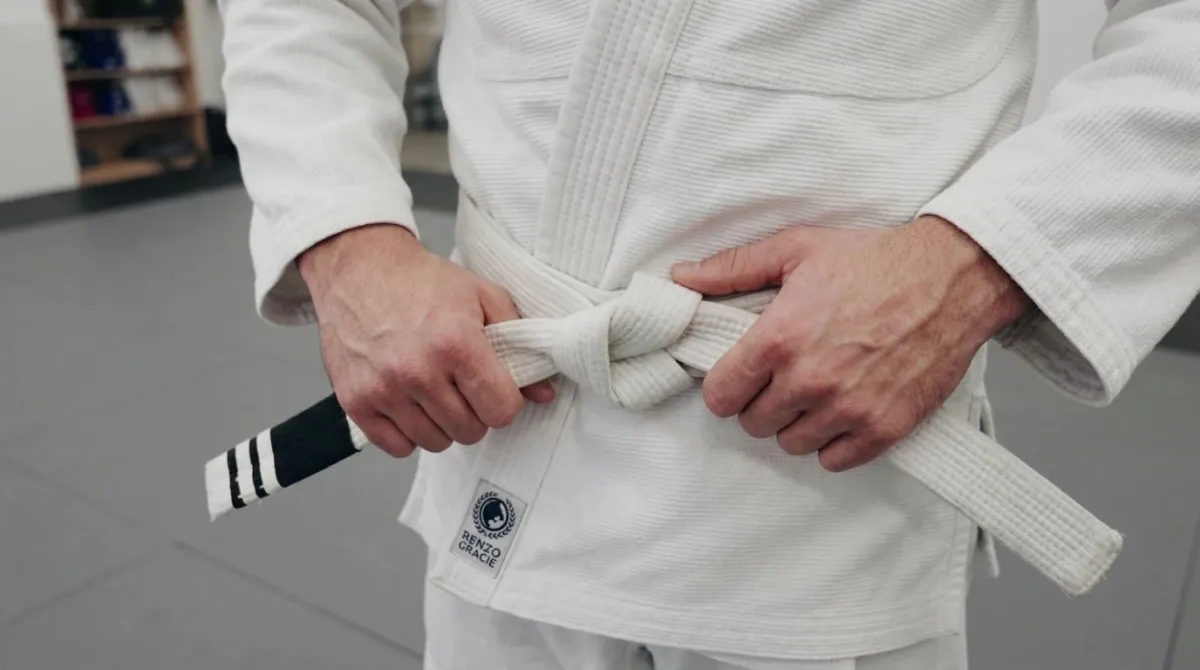
Stripes are small pieces of tape on the belt that show progress within a rank. Many academies give them between belts as encouragement, but each school decides how and when. Receiving a stripe is a nice moment, yet it is not a promise about when the next belt arrives.
Do not compare your stripes with those of friends at other academies. Rules differ, and what counts is the learning behind them.
Is it okay to want a blue belt?
Of course. Wanting to grow is natural, and the first color change is a milestone that many people remember for life. The key is to keep that desire healthy. Use it as motivation to train well, rather than a reason to feel behind.
It also helps to remember what the belt really represents. A blue belt is not the finish line; it is a sign that you have built a foundation, and the real work of refining your jiu-jitsu continues for years. Keep the long view and the journey becomes more enjoyable.
How can you start your journey in Boca Raton?
Start by stepping onto the mat. You do not need experience, and you do not need to be fit. Our coaches will guide you through your first class, explain how the belt system works at our academy and answer your questions honestly.
Look at the adults program and the class schedule to find a time that fits your week. If you prefer a women-only environment, the women's program is a welcoming option. Then book your free trial class and take the first step on a path that rewards patience.
Preguntas frecuentes
Is there an average time to reach blue belt?
There is no official average, and numbers online vary widely. Because instructors decide promotions based on skill, attitude and consistency, the timeline differs for each student. Talk with your coach about your progress instead of comparing yourself with others.
Can I speed up my promotion by training every day?
Training more can help, but it is not a guarantee, and rest matters too. Injuries and burnout slow progress more than anything. A sustainable rhythm that you can keep for months works better than a short, intense burst.
Do stripes mean I am close to the next belt?
Not necessarily. Stripes are small markers of progress that each academy uses in its own way. They are encouraging, but they do not promise a specific promotion date.
What if I feel I am not improving?
Plateaus are normal. Ask your instructor for feedback, drill the basics, rest and keep attending. Progress often arrives after a stretch where nothing seems to change.

 Spanish