
BJJ Belt System Explained: Ranks, Stripes and Time
The BJJ belt system ranks students from white belt to black belt, with blue, purple and brown in between. Stripes on the belt mark smaller steps inside each rank. Promotion is decided by your instructor and reflects technique, understanding, attendance and character, not just competition results or time on the mat.
Every new student asks about belts sooner or later, and for good reason. The BJJ belt system is the visible map of your progress. It tells your training partners what you have worked on, how long you have been learning and where you are headed next.
What is the BJJ belt system?
The BJJ belt system is a ranking ladder that tracks a student's technical growth, experience and character in Brazilian jiu-jitsu. Adults begin at white belt and progress through blue, purple and brown before reaching black belt. Stripes sit on the belt between ranks to mark smaller steps along the way.
Unlike some sports, jiu-jitsu does not hand out belts quickly. A rank is meant to mean something, so most academies promote slowly and deliberately. In our classes we remind students that a belt does not make you better, it simply reflects work that you have already done.
The system also gives the academy a shared language. When a white belt partners with a purple belt, both know roughly what to expect, and the senior student knows to adjust pace and intensity.
What are the adult belt colors in order?
The adult belt colors in Brazilian jiu-jitsu are white, blue, purple, brown and black, in that order. Each belt represents a different stage: building the basics, developing a personal game, refining details, mastering the art and finally teaching it to others. Black belt is not the end, only a new beginning.
- White belt: Learning the language, positions and safe habits.
- Blue belt: Building a base of escapes, guards and submissions.
- Purple belt: Connecting techniques and developing a style.
- Brown belt: Polishing details and understanding deeper strategy.
- Black belt: Showing mastery and the responsibility to guide others.
Black belts continue to progress through degrees over many years, and the highest ranks, such as red and black or red belts, are reserved for those who have contributed to the art for decades. Most students will never need to think about that far ahead.
What does each belt really mean?
Each BJJ belt represents a stage of learning rather than a fixed skill level. A white belt is a beginner who is learning to survive and stay calm. A blue belt has a working base. A purple belt has direction, a brown belt has refinement, and a black belt has depth and teaching responsibility.
White belt: learning to stay calm
The white belt stage is about building good habits. Students learn how to move their hips, protect their necks and arms, and remain relaxed under pressure. It is also where you learn tapping etiquette. In our classes we often see that the students who focus on comfort first improve fastest.
Blue belt: building a toolkit
At blue belt, students have enough experience to defend and attack with some confidence. They start to notice which positions feel natural. This stage can be challenging, since progress seems slower than in the first year. Many students find that patience and steady attendance matter most here.
Purple belt: finding a style
Purple belts begin to connect their techniques into a personal game plan. They help teach newer students, and they begin to understand why moves work, not just how. Strategy, timing and efficiency become central.
Brown and black belt: refinement and responsibility
Brown belts polish the details and prepare for the leap to black belt. Black belts are expected to show technical depth, sound judgment and respect for others. The belt marks a new level of responsibility to protect and guide the students around them.
How do stripes work on a jiu-jitsu belt?
Stripes are small pieces of tape placed on the black bar at the end of a belt to mark progress within a rank. Many academies give up to four stripes before a student is considered for the next belt. Stripes give students regular milestones in a journey that can take years.
The exact way stripes are awarded can differ from one academy to another. Some instructors award them at set intervals, and others do so when a student shows specific progress. Ask your instructor how it works at your academy, so that you know what to expect.
It is worth remembering that stripes are encouragement, not a contract. Earning three stripes does not mean an immediate promotion, and a student can stay at a stripe level while building the skills and consistency a new belt requires.
How are promotions decided?
In jiu-jitsu, the instructor decides when a student is promoted. They look at technical knowledge, performance during rolling, consistency of attendance, attitude toward training partners and, for some students, competition experience. Promotion is a judgment about the whole student, not a test with a single score.
That is why belts can differ slightly between academies. A blue belt from one school may emphasize different areas than another, but a respected rank always reflects real time and effort on the mat.
Here are the things we usually weigh:
- How well you understand the fundamentals and can use them under pressure.
- How consistently you attend and keep improving over time.
- How you treat partners, including smaller and newer students.
- How you respond to mistakes and to feedback.
Notice that none of these is about winning. Competition can help, but plenty of excellent students never compete.
How long does each belt take?
Time at each belt varies widely, and no official schedule applies to every student. As a general idea, each belt takes several years of regular training, and black belt is a long-term commitment. Frequency, quality of training and individual learning pace all change the timeline.
Some students advance faster because they train more often or have athletic backgrounds. Others take longer because of work, family or injuries. Neither path is wrong. We encourage students to focus on the next lesson instead of the next color.
Comparing yourself to others is the quickest way to feel discouraged. The mat is full of students with different bodies, schedules and goals, and your belt only has to measure your own journey.
How do kids belts work?
Kids in jiu-jitsu follow a different belt sequence made for young students. Common youth colors include white, gray, yellow, orange and green, often with variations in between. The extra steps give children frequent goals, which is important for focus and motivation, since a year can feel like forever to a child.
Young students are promoted when they show progress in technique, listening, effort and behavior. Instructors pay close attention to how children treat others, since character is a core part of their growth.
Parents can learn more about how our youth classes are organized by visiting the Little Champions program for younger children and the Juniors program for older kids. Once students reach the age set by the governing organization, they may transition to the adult belt system.
How do you wear and care for your belt?
A jiu-jitsu belt is tied around the waist over the gi jacket with a flat square knot, so the two ends sit even and the knot stays snug through rolling. Students learn to tie it themselves in the first week. A well-tied belt keeps the jacket closed and prevents distractions on the mat.
Treat the belt with respect, because it records your effort. Keep it clean, let it dry fully after class, and never leave it on the floor. Some traditions say a belt should never be washed too often, but modern hygiene matters, so wash the gi regularly and ask your instructor about belt care if you are curious.
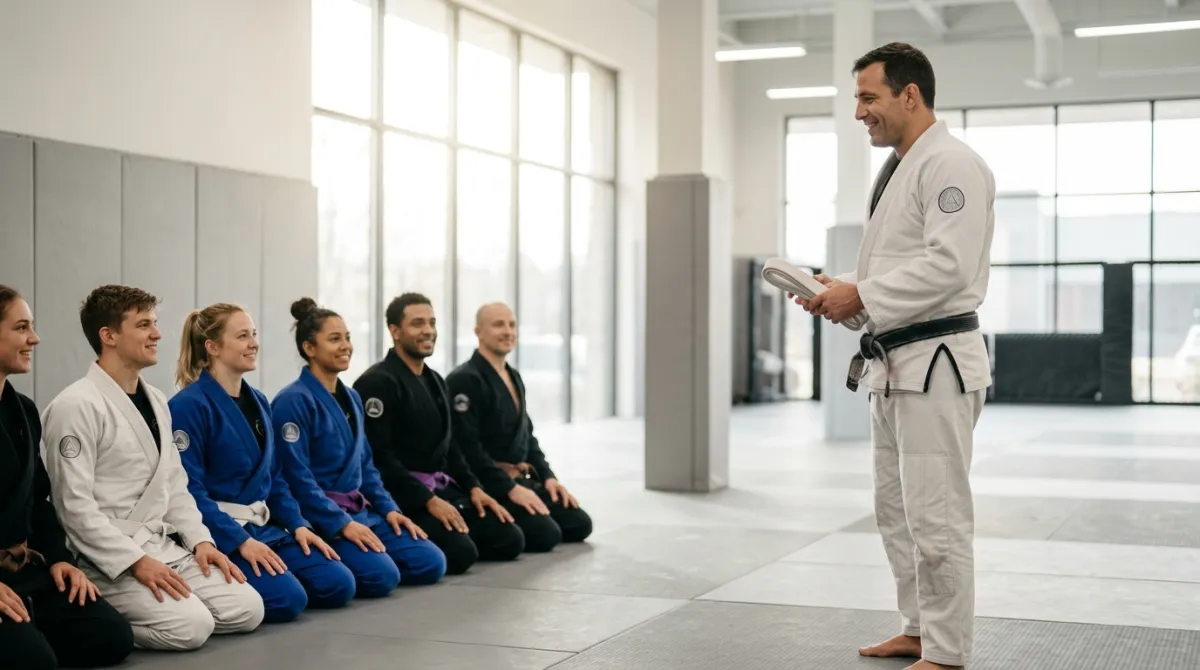
When you earn a new belt, the moment is usually shared with the class. Students line up, the instructor ties the new belt and training partners offer congratulations. In our classes we like these small ceremonies, since they remind everyone why we train.
Do belts mean the same thing everywhere?
Belt standards differ somewhat from one school to another, but the basic ladder and its meaning are widely shared. A blue belt at one academy and a blue belt at another both indicate a student who has learned the fundamentals, although their strengths and training styles may differ.
Governing organizations publish guidelines for minimum ages and minimum time at some ranks, especially for competition divisions. These rules help keep the ladder consistent, though each instructor still decides when a student is ready.
If you move to a new city or academy, bring your belt and an open mind. Most instructors welcome visiting students, and you will quickly find that the common language of jiu-jitsu travels well.
Should you worry about your belt?
No. Your belt matters less than the quality of your training. A healthy attitude toward belts keeps you focused on learning, sharing knowledge and enjoying the process. Students who obsess over rank often stall, while those who stay curious usually improve steadily and enjoy the journey.
Once you start training, you will quickly notice that higher belts are usually the first to help beginners. That generosity is a core value in jiu-jitsu. Rank carries responsibility, not entitlement.
Keep your focus on small wins: a cleaner escape, a calmer breath under pressure, a technique that finally clicks. Those moments are what make the belt system meaningful.
Is the competition team a faster path to a belt?
The competition team does not automatically lead to faster promotion. It offers more intense training and a chance to test skills against other schools, which many students find valuable. Promotion still depends on the full picture of your development, as judged by your instructor.
If you are curious about competing, read about our competition team. Remember that choosing not to compete is completely fine, and it will never limit your place in class.
How can you start your own belt journey?
Every black belt started as a white belt who was not sure what to expect. Starting at Renzo Gracie West Boca Raton means joining a structured path with experienced instructors, a clear curriculum and a community that values respect. The adult program is the best place to begin.
The simplest first step is a free trial class. Come to the mat, try a lesson and ask about the belt system in person. The team will gladly walk you through how ranks and stripes are handled. Your first belt is already waiting.
Frequently asked questions
How long does it take to get a black belt in jiu-jitsu?
There is no fixed timeline. Black belt usually takes many years of consistent training, and each student progresses at a different pace. Attendance, learning style, competition goals and life circumstances all matter. Your instructor evaluates your skill and character, so focus on steady improvement rather than a calendar.
Do stripes mean I will be promoted soon?
Not necessarily. Stripes are small markers that show progress inside a belt level, and a student can hold several before moving up. Promotion depends on your instructor's judgment of your overall development, so use stripes as encouragement rather than a countdown to the next color.
Do I have to compete to earn a belt?
No. Competition is optional at our academy, and plenty of students earn belts without ever stepping on a tournament mat. Competing can sharpen your skills, but instructors also look at classroom performance, technical knowledge, attitude and respect for training partners when they consider a promotion.
Are kids belts different from adult belts?
Yes. Children follow a separate color sequence designed for young students, with more steps so they have regular goals as they grow. Youth students can move into the adult system once they reach the age set by the governing organization, and instructors help families understand that transition.

 English