
Gracie Family History: How Jiu-Jitsu Reached the World
Esta página ainda não foi traduzida; mostrando a versão em inglês.
Gracie family history is central to the story of Brazilian jiu-jitsu. Japanese judoka Mitsuyo Maeda taught Carlos Gracie in Brazil, and Carlos and his brothers, especially Hélio, refined the art around leverage and technique. Later generations carried it to the United States and the early UFC, introducing it to a worldwide audience.
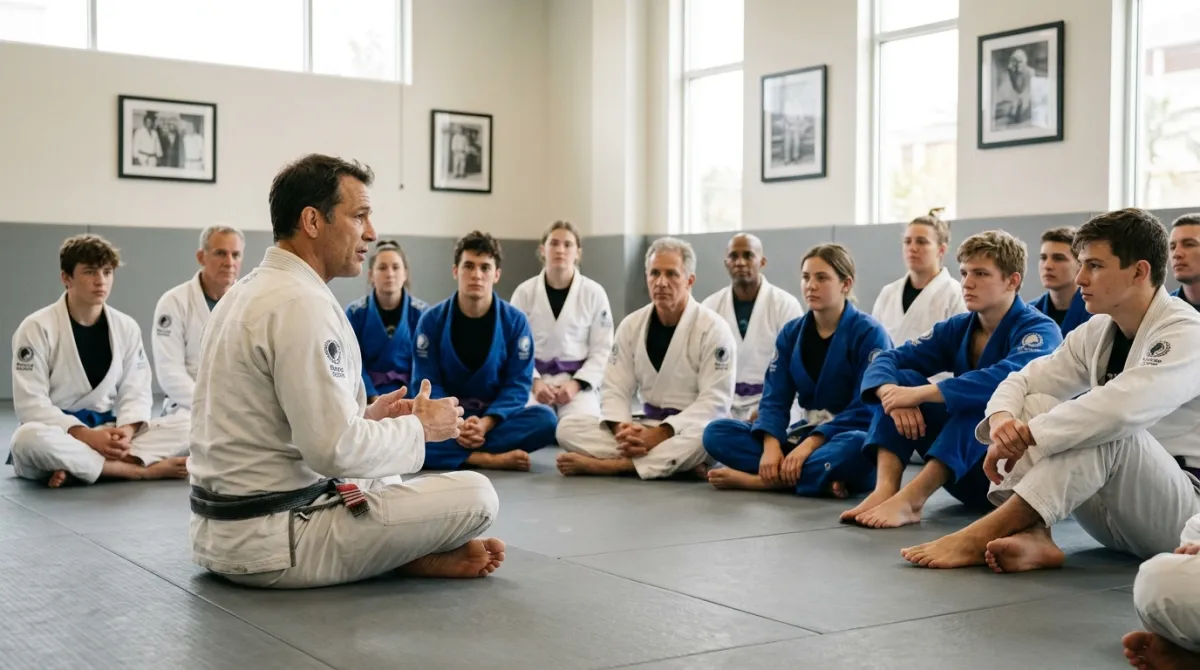
Few martial arts have a story as widely told as Brazilian jiu-jitsu. It crosses oceans, generations and rival schools. The Gracie family history is a major thread in that story, and understanding it helps explain why the art looks, feels and teaches the way it does today.
Where did Brazilian jiu-jitsu begin?
Brazilian jiu-jitsu began in the early twentieth century when Japanese judo and jujutsu knowledge reached Brazil through Mitsuyo Maeda. Maeda traveled widely, taught in several countries and settled in Brazil. Students there, including members of the Gracie family, adapted what they learned into a style focused on ground technique.
The art did not appear in one moment. It grew from the exchange of ideas between Japanese teachers and Brazilian students, who tested and refined techniques over years. Many historical details are debated, and accounts differ in small ways.
We prefer to tell this history in general terms we can stand behind. In our classes we want students to appreciate the roots without getting lost in legends.
Who was Mitsuyo Maeda?
Mitsuyo Maeda was a Japanese judoka and fighter who traveled internationally in the early 1900s and eventually settled in Brazil. He is remembered as a key teacher who passed Japanese grappling knowledge to Brazilian students. His influence on the development of BJJ is widely acknowledged.
Maeda is often known by the nickname Conde Koma. He trained in Japan under the Kodokan judo system and later competed and demonstrated in several countries. In Brazil, he taught students who would carry his methods forward.
It helps to remember that BJJ belongs to a wider family of grappling arts. Judo, jujutsu and Brazilian jiu-jitsu share roots, and each has its own emphasis and rules.
How did Carlos and Hélio Gracie shape the art?
Carlos Gracie learned from Maeda and taught his brothers, including Hélio, the youngest. Carlos helped spread and organize the teaching, while Hélio is widely credited with refining techniques around leverage, timing and efficiency. Together they built a family system that emphasized practical grappling.
Hélio was reportedly smaller and lighter than many opponents, and that shaped how the family approached technique. By relying on angles and timing instead of strength, they developed methods that smaller practitioners could use effectively.
The family opened an academy in Rio de Janeiro in the 1920s, and it became a center for teaching. Over the decades, the Gracie name became closely associated with the art.
Why was leverage so important?
Leverage was important because it allowed practitioners to control larger partners without relying on force. Brazilian jiu-jitsu teaches how to use hips, angles, balance and timing so that small movements have big effects. This principle explains why the art is welcoming to people of many sizes.
- Position before submission: Control comes first, finishes follow.
- Efficiency: Use the least effort needed to achieve a result.
- Adaptability: Adjust techniques to different body types.
- Patience: Wait for the right moment instead of forcing a move.
These ideas remain the heart of how classes are taught today. Beginners often discover them in their first month, when a small adjustment suddenly makes a technique work.
How did jiu-jitsu reach the United States?
Jiu-jitsu reached the United States in the late twentieth century when members of the Gracie family moved there, opened schools and shared the art. Their demonstrations and challenges drew attention, and students began to spread the system across the country.
In 1993, the first Ultimate Fighting Championship took place, and Royce Gracie won early events competing against fighters from other styles. These results introduced Brazilian jiu-jitsu to a global audience and sparked widespread interest in ground fighting.
Since then, BJJ schools have opened in cities around the world. Today the art includes sport competitions, self-defense instruction and programs for children, women and older adults.
What is the connection to Renzo Gracie?
Renzo Gracie is a well-known member of the Gracie family and a respected figure in the martial arts world. His name is carried by academies that share his commitment to the art. Renzo Gracie West Boca Raton teaches Brazilian jiu-jitsu in that tradition of technique, respect and community.
We keep our statements about the academy simple and honest. For details about our instructors and their backgrounds, please visit the instructors page, where the team can tell its own story.
Whatever the name on the door, the best way to understand a lineage is to train. Come to class, ask questions and let the instructors share what they know.
Is BJJ only about one family?
No. The Gracie family played a major role, but Brazilian jiu-jitsu is the work of many teachers, students and academies. Competitors, coaches and communities around the world have contributed techniques, training methods and values. Respecting that wider history is part of good academy culture.
Different lineages emphasize different details. Some focus on self-defense, others on sport, and many blend both. Students benefit when they approach the art with curiosity and humility.
The history is also a reminder that jiu-jitsu keeps evolving. New ideas, new competitors and new students continue to shape the art you practice today.
Which stories deserve a careful approach?
Several famous jiu-jitsu stories deserve a careful approach because accounts differ and details have been retold many times. Dates, challenge matches and rivalries are often described differently by different sources. When in doubt, treat dramatic claims as stories until you can confirm them from reliable historical writing.
Some myths are easy to spot. The idea that BJJ comes from ancient monks in India, for example, is a legend that serious historians do not support. The documented path runs through Japan and then Brazil.
We encourage students to read widely, ask teachers and compare sources. Good history, like good technique, is built on careful attention to detail.
Why does the history matter for beginners?
History matters for beginners because it explains the values behind the techniques: respect, patience and efficiency. Knowing where the art came from gives context to the bowing, the belts and the emphasis on leverage. It makes training feel like part of a story that stretches back more than a century.
It also encourages humility. Every student, no matter how talented, stands on the shoulders of teachers and training partners who came before. That awareness helps keep egos in check.
If you want to see how the tradition lives today, read about our adult program, the Juniors program or the competition team.
How can you experience the tradition yourself?
You can experience the tradition by stepping onto the mat. Renzo Gracie West Boca Raton offers a free trial class where you can meet the instructors, learn a few fundamentals and feel what makes Brazilian jiu-jitsu special. No experience is required, and every class begins with the basics.
Book your free trial class and see the class schedule to choose a time. We welcome beginners from Boca Raton and across South Florida.
Perguntas frequentes
Who taught the Gracie family jiu-jitsu?
Historical accounts say Carlos Gracie learned from Mitsuyo Maeda, a Japanese judo and jujutsu expert who lived in Brazil in the early twentieth century. Carlos then taught his brothers, including Hélio, and together the family developed what became Brazilian jiu-jitsu.
What did Hélio Gracie contribute to the art?
Hélio Gracie is widely credited with emphasizing leverage and timing over strength, adapting techniques so that smaller practitioners could succeed against larger ones. His approach helped shape the style now known as Gracie jiu-jitsu, and he remained influential in the art for decades.
How did the Gracie family bring jiu-jitsu to the United States?
Members of the family moved to the United States in the late twentieth century, opened schools and helped organize the first Ultimate Fighting Championship in 1993. Royce Gracie won early UFC events, drawing wide attention to the effectiveness of ground fighting.
Is Brazilian jiu-jitsu only about the Gracie family?
No. The Gracie family played a major role, but many instructors, academies and lineages have contributed to BJJ. The art continues to evolve through contributions from competitors and teachers around the world, and respect for that wider history is part of academy culture.

 Portuguese