
How Jiu-Jitsu Teaches Kids to Handle Conflict Without Fighting
Jiu-jitsu teaches kids to handle conflict without fighting by building self-control, empathy and calm problem-solving. Children practice stopping on a signal, respecting a partner, staying composed under pressure and choosing words before force. The mat becomes a safe place to learn how to feel strong without being aggressive.
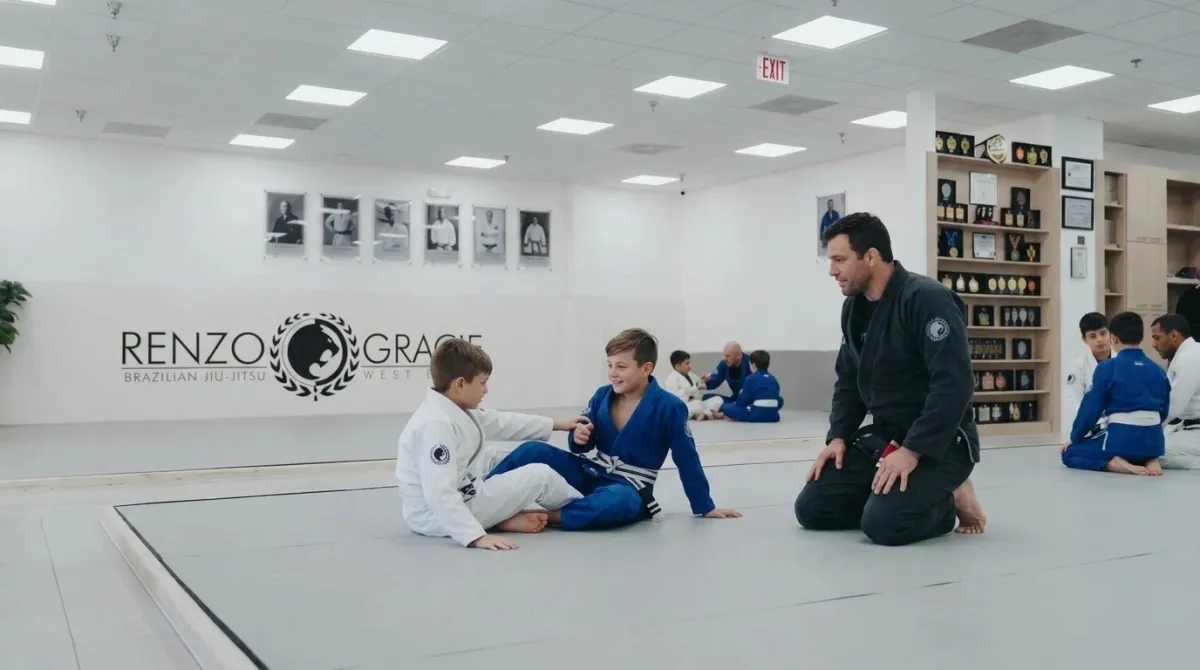
Parents sometimes ask a surprising question: will martial arts make my child more aggressive? In a well-run academy, the answer is the opposite. A child who has learned to control their body and calm their mind often has less need to prove anything. This article explains how that happens, and what the limits are.
Does martial arts make children aggressive?
In a well-run academy, no. Good programs teach rules, respect and self-control from the first class. Children learn that strength is for training and protection, not for showing off. Instructors correct aggression quickly and kindly.
Problems can arise in schools that glorify fighting or ignore bad behavior. That is why the choice of academy matters. Watch how instructors handle conflict and how students speak to each other.
Our post on jiu-jitsu and bullying explains how we approach this topic.
How does the tap teach self-control?
The tap is a simple signal that means stop. When a child taps, their partner must release immediately. Children learn to respect that signal in both directions: to give it when needed and to honor it from others.
This creates a culture of boundaries. A child practices saying stop, hearing stop and acting right away. Those habits translate directly to playground disagreements and family life.
Over time, children learn that stopping is not weakness. It is a mark of control and maturity.
How do kids learn to stay calm under pressure?
On the mat, children sometimes feel stuck, held or surprised. They learn to breathe, think and look for a solution instead of panicking. That experience, repeated many times in a safe setting, builds emotional steadiness.
Instructors coach this directly: slow down, breathe, move your hips, try another way. Children hear these words so often that they begin to repeat them to themselves. The inner voice becomes calmer.
We are not offering clinical treatment for emotional challenges. If your child struggles with anger or anxiety, talk with your pediatrician or a qualified professional. Jiu-jitsu can be a positive complement.
What role does respect play?
Respect is built into every class. Children bow, thank partners, wait for turns and listen to instructors. They learn to treat everyone with courtesy, whether the partner is a close friend or a new student.
Respect also means paying attention to size and experience. Older and stronger students learn to adjust their power to protect younger ones. This sense of responsibility shapes character.
Our etiquette guide describes the habits that make a mat feel safe and welcoming.
What do kids learn about words and walking away?
A good academy teaches that the best fight is the one you avoid. Children are encouraged to use words, set boundaries, ask for help and walk away from trouble. Technique is a last resort.
Role-play can help. Instructors or parents can practice phrases such as 'Stop, I do not like that' or 'I am going to get a teacher.' Children rehearse tone of voice and body language, which makes them feel prepared.
Remind your child that telling an adult is not tattling. It is a smart, brave choice.
How can parents reinforce these lessons?
Parents can reinforce lessons by modeling calm behavior and talking about conflict at home. When your child has a disagreement, ask questions rather than lecturing. What happened? How did you feel? What could you try next time?
Some simple practices:
- Name feelings out loud, such as angry, sad or frustrated.
- Practice taking three slow breaths together.
- Praise your child when they handle a hard moment well.
- Talk about stories where characters choose peaceful solutions.
Consistency between home and the mat strengthens the message.
What are the limits of what the mat can do?
Jiu-jitsu is not a guarantee against conflict or bullying. Children still need trusted adults, school support and open communication. Training can build confidence and skills, but it cannot replace attention from parents and teachers.
If your child is being bullied, tell the school and seek support. Do not rely on technique alone. Also remind your child that physical self-defense is only for real danger and never for revenge.
We aim to be honest about what we can offer: a positive environment and useful skills, with no miracle promises.
Which programs fit?
Children of different ages can learn these lessons in Little Champions, Juniors and Teens. Check each page for age ranges and details, and look at the schedule.
If you want to see how our classes feel before deciding, book a free trial class. Bring a water bottle, wear comfortable clothes and watch how your child responds.
What does a conflict look like on the mat?
Conflicts on the mat are usually small: a partner who squeezes too hard, a child who feels the drill is unfair or a disagreement over who goes first. These moments are valuable, because instructors can coach children through them in real time.
A typical resolution is simple. The instructor asks both children to pause, listen to each other and try again. The aggrieved child learns to say what happened, and the other learns to apologize or adjust. Children quickly see that conflict can end calmly, with respect on both sides.
How does physical confidence reduce the need to prove yourself?
A child who knows they can handle a challenge often feels less need to show off. Confidence earned through training is quiet. It lets a child laugh off teasing, stand their ground politely and walk away from a provocation without feeling small.
This does not happen overnight, and it varies from child to child. But many parents tell us that after months of training their children seem more settled. We always encourage parents to watch for these quiet changes and to celebrate them.
How can older kids and teens use these lessons?
Older children face more complex conflicts: group chats, rivalries, pressure from friends. The same skills apply. Pause before reacting, breathe, choose words carefully and know when to seek an adult. Teens who train often learn to read situations and avoid escalation.
Our Teens program gives older students a space to talk about these topics and practice leadership. Mentoring younger students is a powerful way to turn lessons into habits.
How do instructors model calm leadership?
Children learn more from what instructors do than from what they say. A coach who stays calm when a room gets loud, who corrects without shouting and who admits mistakes teaches an unforgettable lesson about leadership.
Watch the instructors during a visit. How do they speak to a child who is upset? Do they listen first? Do they treat everyone fairly? The answers will tell you what your child will absorb, week after week, long before any technique.
What if your child is the one who loses their temper?
Many children lose their temper sometimes. If it happens in class, the instructor will pause the activity, give the child a moment to cool down and welcome them back with a clear expectation. There is no shame in the process, and it is treated as a normal part of growing up.
Talk with your child afterward without judgment. Ask what they felt and what could help next time, such as a deep breath or a short break. Share the plan with the instructor so everyone supports the same strategy. With patience, most children learn to catch the feeling early.
Why should you choose a calm, respectful academy?
The environment shapes the lessons. A calm, respectful academy teaches that strength and kindness go together. Look for instructors who model patience and for students who help each other.
At Renzo Gracie West Boca Raton, we aim to be that kind of place, and we invite you to see for yourself. You can start with the free trial page or ask questions on the contact page.
Frequently asked questions
Will my child use jiu-jitsu to fight at school?
Good academies teach children that techniques are for training and real danger only. Instructors reinforce this often. Talk with your child about expectations and consequences.
Can jiu-jitsu help with anger?
The mat can teach self-control and calm habits. It is not a treatment for anger problems. If you are concerned, talk to a professional.
What should my child do if someone bullies them?
Teach your child to use words, walk away and tell a trusted adult. Technique is for real danger only.
At what age do kids learn this?
Even young children learn rules, taking turns and stopping on a signal. Lessons deepen with age and experience.

 English