
BJJ Myths Debunked: 10 Things Beginners Get Wrong
Esta página aún no está traducida; mostrando la versión en inglés.
Common BJJ myths keep newcomers off the mat: that you must be fit, young, strong or ready to fight. In reality, classes are built for beginners, technique beats strength, and training is cooperative and structured. Understanding the facts makes the first class far less intimidating, and a free trial class lets you see for yourself.
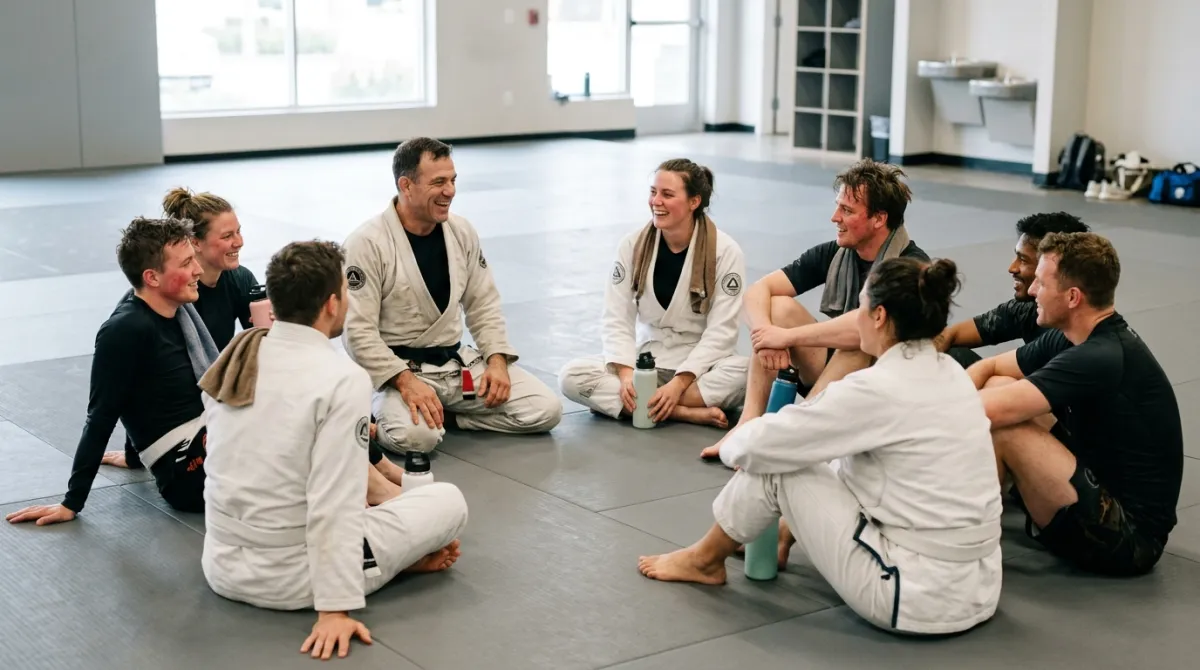
Before many people ever try a class, they have already decided not to. They have heard stories, seen clips or imagined something much scarier than reality. Let us clear up the most common BJJ myths so you can decide based on facts.
Myth 1: Do you need to be in shape first?
You do not need to be in shape to start BJJ. Beginner classes are designed for people at all fitness levels, with warm-ups and drills you can scale. Fitness is something you build through jiu-jitsu, not something you must have before the first class. Rest whenever you need to.
In our classes we often meet people who say they will start after they get in shape. We gently explain that the mat is a great place to begin. The instructor will adjust the pace, and you will see your stamina improve with regular practice.
Waiting for the perfect moment usually means waiting forever. This is one of the BJJ myths that keeps the most people at home, so start where you are.
Myth 2: Is jiu-jitsu only for the young?
Jiu-jitsu is not only for the young. Adults in their forties, fifties and beyond start training every year, and many academies offer classes shaped around mature beginners. This is among the BJJ myths we hear most from adults. The art rewards patience and technique, which suits learners of any age, provided they train sensibly and talk to their doctor.
If you are curious, read about the Tatame 40+ program or the adult program. Both explain how classes work for people starting later in life.
Age changes how you recover, not whether you can learn. Train smart, rest well and enjoy the process.
Myth 3: Does the bigger, stronger person always win?
The bigger, stronger person does not always win in jiu-jitsu. The art teaches leverage, timing and technique, which let smaller students control larger partners. Strength can help, but it is not the main ingredient. This is one reason the sport is popular with women and smaller students.
That said, size and experience both matter, and a skilled big person has advantages. A fair statement is that technique narrows the gap, rather than erasing it. Good partners will adjust their intensity in class so that everyone can learn.
Women who want to see a supportive environment can read about the women's program.
Myth 4: Will you have to fight on day one?
You will not have to fight on day one. A first class includes a warm-up, a technique lesson and partner drilling. Live practice, called rolling, is optional for beginners and is introduced gradually with careful partners. Rolling is a training exercise, not a street fight.
Many people picture a brawl, but a class is much calmer. Students bow, shake hands, work together and tap when needed. Among all BJJ myths, the fight club image is the least accurate. The atmosphere is closer to a workshop than a fight club.
If you feel nervous, tell your instructor. They will make sure your first rounds, if you choose to take them, are with patient partners.
Myth 5: Is jiu-jitsu always dangerous?
Jiu-jitsu is not always dangerous, although every contact sport carries some risk. Good academies reduce risk with warm-ups, supervised drills, clear rules and a strong tapping culture. Students who train sensibly and communicate often practice for many years without serious problems.
- Tap early and often, since tapping is smart, not weak.
- Choose partners who are controlled and respectful.
- Tell your instructor about injuries right away.
- Rest when you are sick or very tired.
No one can promise total safety. See a doctor if you have a medical condition, and follow the academy's rules.
Myth 6: Do you need to be flexible?
You do not need to be flexible to start jiu-jitsu. Some movements ask for hip and spine mobility, but you build it gradually, and techniques can be adapted to your body. Many stiff beginners become noticeably more comfortable after a few months of consistent practice.
Warm-ups include gentle movements like bridging and shrimping, which improve mobility over time. If a position feels uncomfortable, tell your instructor and your partner. There is always a way to modify.
Myth 7: Do belts come quickly?
Belts do not come quickly. Brazilian jiu-jitsu promotions are earned slowly, and each rank represents years of learning, not weeks. Instructors consider technique, knowledge, attendance and character, so a belt reflects the whole student. Chasing belts usually slows progress.
The colors and stripes follow a set ladder from white to black. Remember this: a belt marks where you have been, not what you must prove.
That slow pace is part of the art's charm. Each small step feels earned, and the journey is the real reward.
Myth 8: Is it only for people who want to compete?
Jiu-jitsu is not only for competitors. Most students train for fitness, friendship, self-improvement and fun, and many never enter a tournament. Dispelling BJJ myths about competition matters, because competition is one path among many, and choosing not to compete will never limit your place in class.
If competition does interest you, the competition team offers a structured path. Everyone else can simply enjoy learning and growing at their own pace.
Myth 9: Is the gi a hurdle for beginners?
The gi is not a hurdle. It is simply a sturdy uniform that jiu-jitsu students wear to practice grips and control. You do not need to own one for your first class, and many academies also teach no-gi classes in a rash guard and shorts. Ask the team what is available.
New students sometimes worry about looking silly or spending money before they are sure. Relax. Try the class first, learn how the uniform works and decide later. Everyone on the mat started without a gi at some point.
Myth 10: Will it take over your life?
Jiu-jitsu will not take over your life unless you want it to. Most students train a few times a week and keep their jobs, families and other hobbies. The art fits around your schedule, and you can start with just one or two classes a week.
Some people do become passionate and train more, and that is also fine. The point is that you choose the pace. Our class schedule offers a range of times, so you can build a rhythm that fits your life.
What is the truth about a first class?
The truth about a first jiu-jitsu class is that it is friendly, structured and designed for beginners. You will warm up, learn a technique, drill it with a partner and perhaps try a light round. Nobody expects you to be good, and everyone remembers their first day.
Seeing is believing. A free trial class at Renzo Gracie West Boca Raton lets you test every myth for yourself. Check the class schedule and choose a time that works. We look forward to meeting you in Boca Raton.
Preguntas frecuentes
Do you have to be in shape before you start BJJ?
No. Beginner classes are paced so you can start at your current fitness level. The warm-up and drills build conditioning over time, and you can rest whenever you need to. Tell your instructor about any concerns so they can guide you through your first weeks.
Will I be forced to fight in class?
No one is forced to do anything. Jiu-jitsu classes are cooperative and structured, with drilling and light practice rounds. Beginners can start by watching or drilling, and live rounds are added when you feel ready. You can always say no or tap out.
Is it only for young, athletic people?
No. Students of many ages and body types train, and some academies have programs for mature beginners. Technique, patience and consistency matter more than athletic talent. You will find classmates with all kinds of backgrounds on the mat.
Does jiu-jitsu always lead to injuries?
Any physical activity carries some risk, but good academies reduce it with warm-ups, supervised drills, controlled partners and early tapping. Communicate with your instructor, listen to your body and see a doctor for any lasting pain.

 Spanish