
Side Control in Jiu-Jitsu: Definition and Basics
Esta página aún no está traducida; mostrando la versión en inglés.
Side control is a pinning position where you lie across your partner's chest, perpendicular to their body. The top player uses chest pressure to control them, while the bottom player uses frames and hip movement to escape.
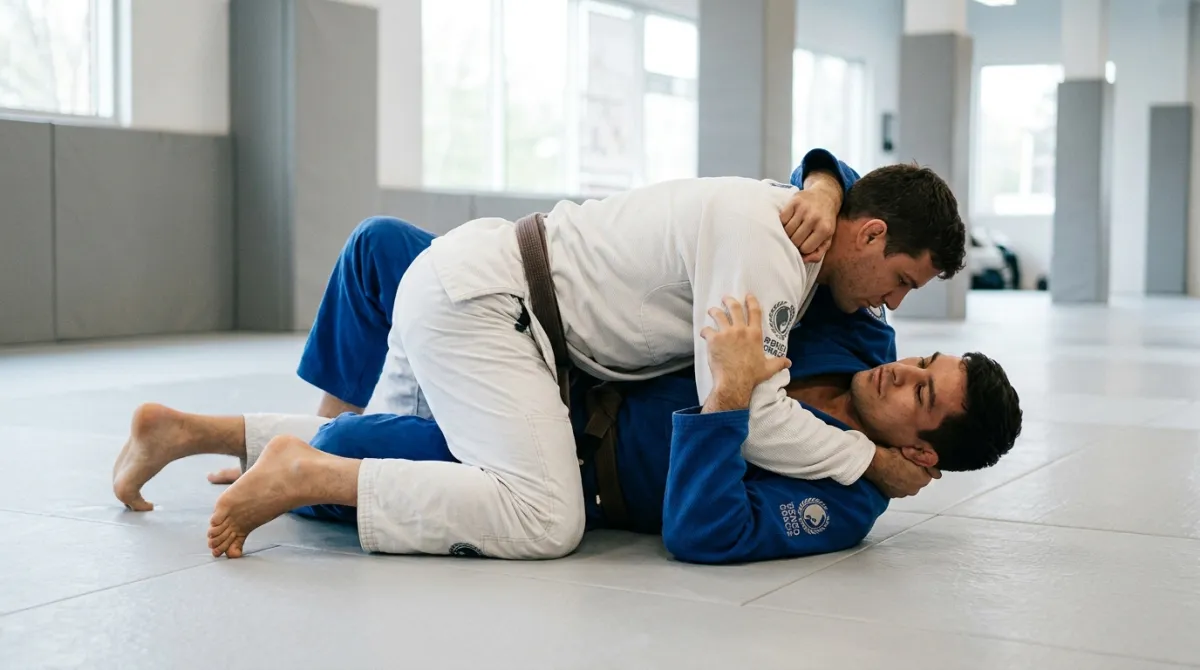
Side control is a top position in which you lie across your partner's chest, at a right angle to their body, with your chest on theirs and your hips low. It is a basic pin, and many students spend their first months learning how to hold and escape it. It also sits between guard passing and mount.
How the top player controls
The top player keeps their hips low and their weight over the partner's chest. One arm usually controls the far side, and the other blocks the hips. Pressure comes from the chest and shoulder, not from hurting the neck or face. If the partner stalls, the top player can transition to mount or attack with a submission.
How the bottom player escapes
The bottom player builds frames with the forearms on the hip and shoulder, bridges to make a small gap, and shrimps away to bring a knee back in. The calmer the frames, the easier the escape. A step-by-step version is in our side control escape technique.
A short example
After passing the guard, you land on your partner's side. You pin their hips with your forearm, slide your chest high, and wait for a mistake. If they turn away, you follow. If they bring a knee in, you switch to a different grip.
Safety matters in this position because pressure can be heavy. Communicate, tap early, and train with a qualified instructor. Our coaches teach it gently in a free trial class, and you can compare it with the mount.

 Spanish